
Choosing the right Conveyors Roller in 2026 requires more than comparing prices. Global buyers must examine load weight, belt speed, moisture, temperature, and maintenance access. A roller that performs well in a dry warehouse may fail beside a port, quarry, or refrigerated facility. Small details matter. Seal quality matters. Shaft strength matters.
Conveyor engineer Martin Engineering specialist Daniel R. Hargrove says, “A dependable roller is not simply round steel; it is controlled movement, protected bearings, and predictable maintenance.” This principle guides our review of the 2026 market. We will compare impact rollers, return rollers, gravity rollers, and powered conveyor options. We will also consider steel, stainless steel, and polymer designs. Each material has a different purpose. None is perfect.
Real purchasing decisions are often less tidy than product brochures suggest. A low-cost roller can increase noise, belt wear, and replacement labor. An expensive model can be unnecessary for light cartons. That is where buyers need measured judgment. Ask for load ratings, bearing specifications, surface treatments, and installation guidance. Request test records when conditions are demanding. Check whether replacement parts are available locally. This guide focuses on practical performance, not impressive wording. It also admits an uncomfortable point: available data is sometimes incomplete. Buyers should verify every critical specification with the manufacturer before ordering.
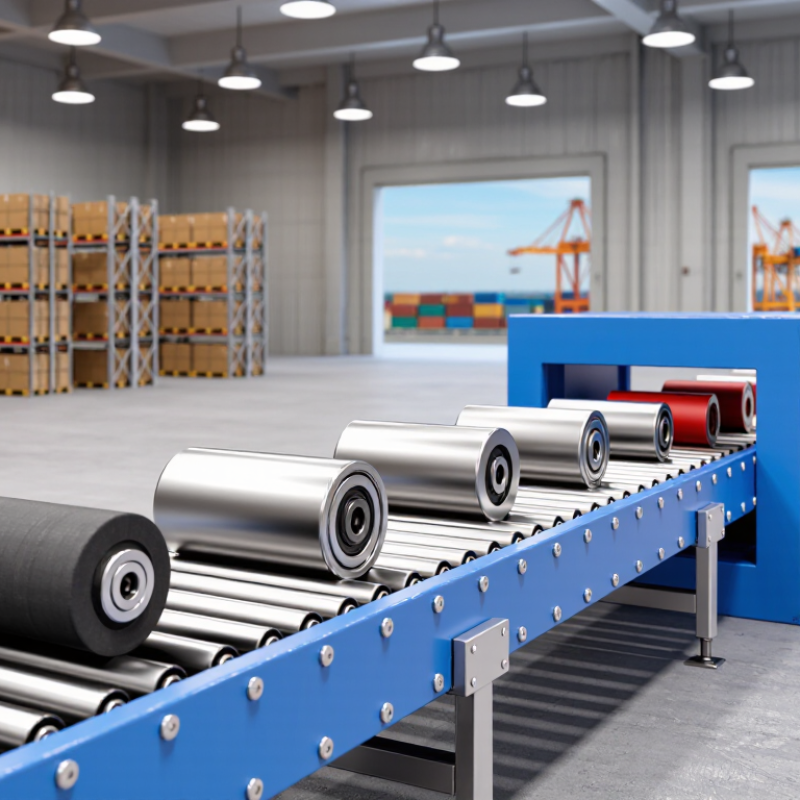
Conveyor rollers support, guide, and move materials across a handling system. Gravity rollers work well for cartons, totes, and light pallets on a slight incline. Powered rollers use motors or drive belts when loads need controlled movement. Choose carefully. A roller that turns smoothly when empty may stall under a dense load.
Roller design affects speed, noise, and service life. Steel rollers suit demanding industrial work, while aluminum reduces weight in cleaner applications. Plastic rollers resist moisture and can protect delicate packages from surface damage. Tapered rollers help products follow curves without drifting. Grooved rollers improve belt tracking or support round items. Impact rollers, often fitted near loading points, absorb shock from falling materials.
In practical inspections, I check tube diameter, shaft size, bearing clearance, and seal quality. These small details often decide whether a conveyor runs quietly or develops early vibration. Stainless or coated components may perform better in humid areas, but coating quality still matters. No design fits every line. That is the difficult part. Buyers should compare load capacity, operating temperature, cleaning methods, and replacement access before ordering. A common mistake is selecting by price alone. It can create higher downtime, uneven product flow, and unnecessary labor.
Choosing conveyor rollers starts with the material, not the catalogue. Cartons need smooth movement and low noise. Heavy pallets require larger tube diameters, stronger shafts, and accurately rated bearings. For gravel, ore, or other abrasive loads, impact-resistant rollers and sealed bearings reduce premature wear. Food and washdown areas demand corrosion-resistant surfaces and hygienic construction.
MarketsandMarkets estimated the global conveyor system market at about USD 10.6 billion in 2023, with continued growth expected through 2028. This growth reflects wider automation, but automation does not forgive poor roller selection. CEMA engineering guidance emphasizes load, belt speed, spacing, and bearing performance. A roller may carry the stated weight yet fail under shock loading. That detail is often missed.
Measure the real load pattern. Include product gaps, side impacts, moisture, dust, temperature, and daily operating hours. Use a slower roller speed when fragile cartons require controlled handling. Choose closer roller spacing for short or flexible packages. Field inspections often find another issue: frames are misaligned, while the rollers receive the blame. I have seen specifications look perfect on paper and perform poorly on the floor. Recheck shaft fit, runout, and replacement access before purchasing globally. Supplier test reports, material certificates, and clear duty ratings improve traceability, though paperwork alone cannot replace a site trial.
2026 Best Conveyor Rollers for Global Buyers?
When selecting conveyor rollers, load capacity should match the real working condition, not just the catalog figure. Measure the product weight, belt tension, impact points, and spacing between rollers. A roller carrying boxed goods may need less strength than one supporting dense stone or metal parts. Leave a practical safety margin. More is not always better.
Diameter affects rotation, belt support, and product stability. Smaller rollers suit light packages and compact frames, while larger diameters usually handle heavier loads with lower surface pressure. Speed also matters. High-speed lines require balanced rollers, accurate bearings, and controlled runout. During site inspections, I have seen small alignment errors create noise, vibration, and uneven belt wear. The specification looked correct. The installation was not.
Material selection should reflect the workplace. Galvanized steel resists ordinary moisture, stainless steel suits demanding washdown areas, and polymer rollers can reduce noise and product marking. Temperature, dust, chemicals, and humidity deserve written review before purchase. Ask suppliers for load tests, dimensional tolerances, bearing details, and corrosion data. Samples should run under actual conditions when possible. A laboratory result may not predict performance on a cold, dusty warehouse floor. That gap needs attention.
| Roller Type / Typical Use | Common Roller Diameter | Indicative Load per Roller | Typical Line Speed | Common Materials | Selection Notes |
|---|---|---|---|---|---|
| Light-duty gravity roller | 25–38 mm (1–1.5 in) | About 10–50 kg (22–110 lb) | Gravity-fed; speed depends on slope, load, and friction | Galvanized steel, aluminum, or polymer tube | Suitable for small cartons and light packages. Confirm shaft, bearing, frame, and roller spacing ratings. |
| Medium-duty gravity roller | 38–60 mm (1.5–2.4 in) | About 30–150 kg (66–331 lb) | Gravity-fed; controlled speed may require brakes or flow-control rollers | Steel, stainless steel, or aluminum | Often used for cartons, totes, and moderately heavy unit loads. Load capacity varies with roller length and support conditions. |
| Heavy-duty gravity roller | 60–89 mm (2.4–3.5 in) | About 100–500 kg (220–1,102 lb) | Gravity-fed; avoid estimating speed from diameter alone | Thick-wall steel or stainless steel | For heavy packages, pallets, or demanding environments. Check impact loads, shaft deflection, bearings, and conveyor frame strength. |
| Powered roller conveyor | 38–89 mm (1.5–3.5 in) | About 20–500 kg (44–1,102 lb), application-dependent | Commonly about 0.1–1.0 m/s (20–197 ft/min); system-specific | Steel, stainless steel, or polymer-coated steel | Drive type, motor torque, controls, accumulation method, and product contact determine performance and usable load. |
| Accumulation / low-pressure roller | 38–60 mm (1.5–2.4 in) | Typically light to medium unit loads; verify the system rating | Often about 0.1–0.8 m/s (20–157 ft/min); control-dependent | Steel rollers with friction sleeves or polymer components | Designed to reduce product pressure during accumulation. Confirm zone length, load spacing, and control configuration. |
| Corrosion-resistant roller | 25–76 mm (1–3 in) | Varies widely by tube, shaft, and bearing design | Set by the conveyor drive or gravity layout | Stainless steel, engineered polymer, or compatible coated components | For washdown, humid, or corrosive environments. Specify chemical exposure, cleaning method, temperature, and bearing protection. |
Values are general selection ranges, not universal product ratings. Actual load capacity depends on roller length, tube wall thickness, shaft size, bearing design, support spacing, load distribution, and operating conditions. Conveyor speed is determined by the complete system—not roller diameter alone. Confirm manufacturer data and applicable safety requirements before specification.
Comparing the best conveyor roller options for global buyers in 2026 requires more than checking price per unit. Buyers should match roller design to load, speed, humidity, noise, and maintenance access. Gravity rollers suit cartons and moderate flow. Powered rollers provide controlled spacing and accumulation. Tapered rollers improve package alignment around curves. Coated rollers offer better grip for fragile surfaces. Stainless steel performs well in washdown areas, but it costs more and still needs protected bearings.
The International Federation of Robotics reported 541,302 industrial robots installed worldwide in 2023, a 10% increase from 2022. This growth supports stronger demand for automated material handling. MHI’s 2024 Annual Industry Report, based on more than 2,000 industry responses, also identifies robotics and automation as major supply-chain investment areas. This growth supports automation, not every roller specification.
For cross-border sourcing, compare load ratings under identical test conditions. Request tube diameter, shaft material, bearing type, duty cycle, noise data, and replacement lead time. ISO 9001 certification supports process control, but it cannot guarantee roller life. Test samples with real cartons, dust, impact points, and temperature changes.
My early shortlist was too simple. A cheaper roller may create higher labor costs through noise, jams, or frequent replacement.
Regional service capacity matters. So does clear technical documentation in the buyer’s working language.
For global buyers, conveyor rollers should be purchased against operating conditions, not catalog photos. Specify load per roller, belt speed, shaft size, bearing clearance, temperature, humidity, and expected service hours. CEMA dimensional practices and ISO 281 bearing-life calculations provide useful technical references. ISO 9001-certified production can improve process control, but certification alone does not prove roller performance.
Cost comparison must include more than the factory quotation. Add tooling, inspection, inland transport, ocean freight, insurance, duties, spare rollers, and possible downtime. The UNCTAD Review of Maritime Transport 2024 reported that maritime shipping carries over 80% of global merchandise trade by volume. Delivery disruption therefore matters. Request a realistic production schedule, packing drawings, carton dimensions, and a clear replacement policy. Crated steel rollers may survive long routes better, but they also increase freight weight. Small detail. It changes the landed cost.
MHI’s 2024 Annual Industry Report found that 55% of supply-chain professionals planned to increase investment in technology and innovation. This supports automation demand, yet purchasing teams should avoid copying another site’s specification. A warehouse roller may fail in a dusty quarry or cold-storage room. Ask for runout records, material certificates, bearing details, and sample inspection results. Third-party testing can expose weak welds or excessive noise. I have seen low-priced components become expensive after repeated bearing failures. Still, inspection budgets are not unlimited. Buyers must decide which risks deserve measurement before shipment.